By Juulia Ahvensalmi. This text was originally published as 'Morbid appearances', St George's Library Blog, 3 Jun 2020.
We have now catalogued a good chunk of St George’s historical post mortem records, and are preparing to make them available on our catalogue soon. In our blog posts, we’ve been exploring various themes and aspects emerging from the records, from examining cases of leprosy and hysteria, to delving into the social backgrounds and occupations of the patients.
But let’s take a closer look at the records themselves. Do they always contain the same information? How are they structured? What do they actually say? The format doesn’t vary very much: the records we are now cataloguing stretch from 1841 to 1920, and tend to follow the same template, as shown in these images from 1845 and from 1920.
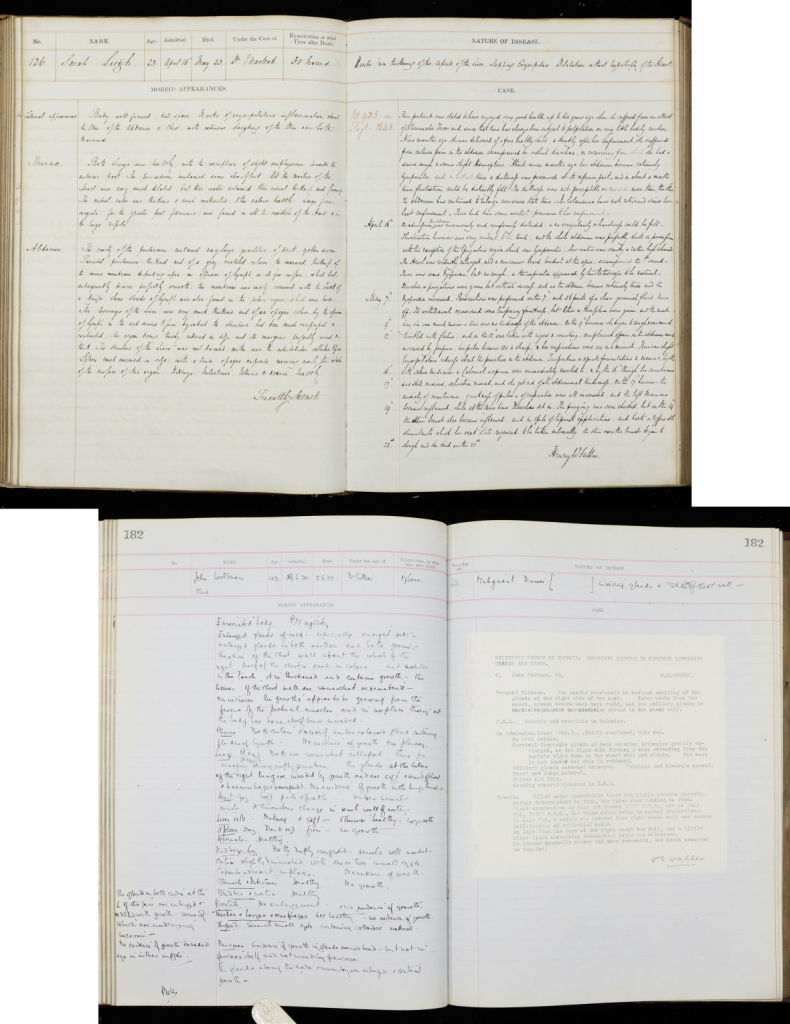 Post mortem examination book 1845 (Sarah Leigh, PM/1845/126) and Post mortem examination book 1920 (John Welburn, PM/1920/182). Archives and Special Collections, St George’s, University of London.
Apart from the two earliest volumes, in which each case occupies only a single page, all the volumes reserve a two-page spread for each individual patient. The labelled boxes across the top of the pages record the patient’s case number, name (sometimes also occupation is noted here), age, date of their admission to the hospital, date of death, the name of the doctor admitting them, the length of time between death and the post mortem examination, references in medical and surgical registers and the ‘Nature of disease’.
This last box details the cause of death, based on the examination. Sometimes the cause is determined to be straightforward, and the box only lists a single ailment (‘Fracture of skull’, ‘Pneumonia’), but more often multiple diseases or other ailments are listed – there is not always a single cause of death, but multiple contributing factors. In the catalogue we are including a transcription of this field, as well as a standardised form of the disease(s), using Medical Subject Headings (MeSH). Treatments (in particular operations) as well as post-mortem changes and features of the body sometimes also appear in this list, and can vary from brief and vague (‘Disease of the heart’) to very long and specific:
‘Renal sarcoma (removed by operation). Accidental inclusion of small gut in abdominal saturation. Volvulus of small gut. Small gut obstruction. Commencing peritonitis’, or
‘Phthisis. Old adhesions of the pleurae. Lymph in pericardium. Atheroma in aorta & mitral valve. Tubercular spots in various parts of the intestines with ulceration of the mucous membrane. Mesenteric glands enlarged’
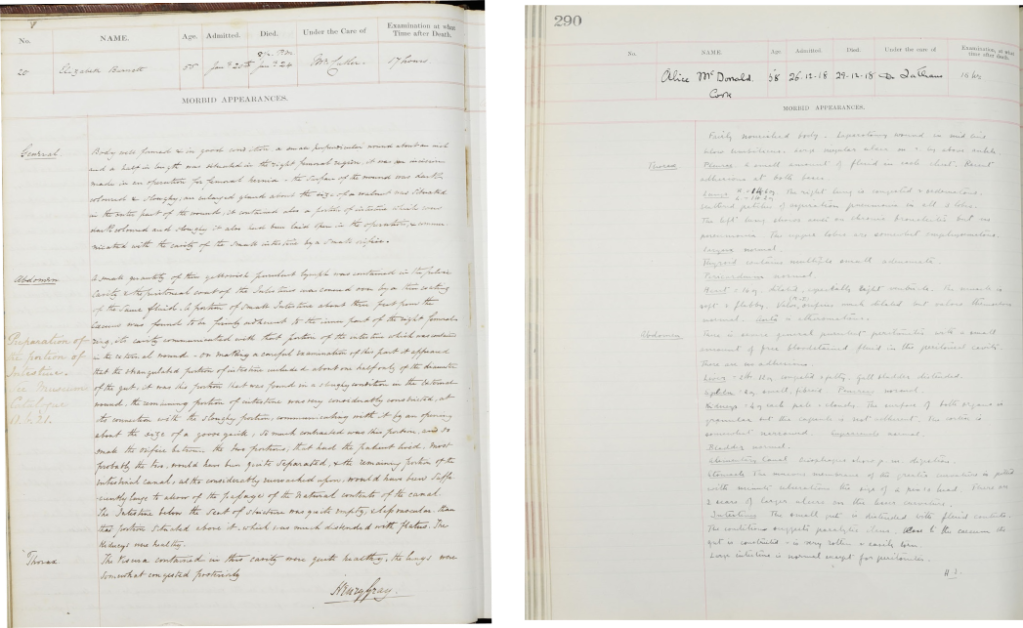 Post mortem case notes for Elizabeth Burnett in PM/1849/20, signed by Henry Gray; and Alice McDonald, PM/1918/290, signed by H.I. (Helen Ingleby). Archives and Special Collections, St George’s, University of London.
The left-hand page, labelled ‘Morbid appearances’, is reserved for the details of the post mortem examination in which, following a general description of the appearance of the body (‘Body well-formed and in good condition…’), each examined part of the body is listed. This is sometimes presented as larger wholes (cranium, thorax, abdomen) or simply as list of organs and body parts that were examined (left hip, skull, lungs, heart, uterus and so on). The bottom of the page is usually signed by the doctor who performed the examination; this tended to be a fairly junior doctor. Sometimes there is more than one name.
Any preparations or samples taken are also listed here, with references to the catalogues of the Pathology Museum of St George’s – as a part of the Post Mortem Project, we are listing these references and attempting to locate them in the museum – the referencing systems have, however, been changed multiple times over the years, so the task is not always that easy.
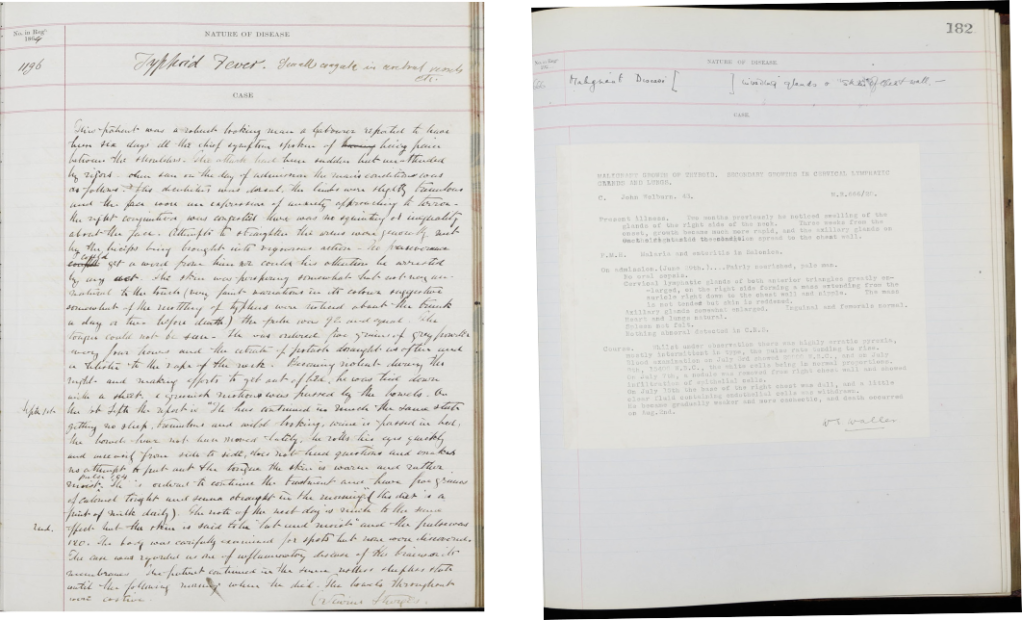 Medical case notes for James Cronin, PM/1864/233, signed by Octavius Sturges; and John Welburn, PM/1920/182, signed by Wathen Ernest Waller. Archives and Special Collections, St George’s, University of London
The right-hand page is for details of the medical case before the patient’s death. This, too, is usually signed by the doctor examining the patient, and is similarly formulaic: first, the history of the case is rehearsed, detailing symptoms and other details, followed by a description of the patient on their admission and details of the treatment(s) received prior to their death. If there is no post mortem examination, no medical notes are included either.
There are of course some differences in the way the case notes are presented during this time – we are, after all, talking of a period of 79 years. Some, although by means not all, of the 20th century volumes contain a carbon copy of typewritten medical notes instead of the more usual handwritten ones (a blessing for the cataloguers, who have to decipher the often rushed handwriting – the later volumes also tend to be more difficult to read!). These notes were copied from the medical and surgical registers recording all admissions to the hospital. Unfortunately, however, we no longer have these registers, so it is impossible to tell whether the notes were copied exactly or changed in the transmission.
 Adjectives in the post mortem volumes. Archives and Special Collections, St George’s, University of London.
Perhaps, however, typing your notes rather than writing them down by hand affected the way the cases were recorded: the later volumes certainly tend to be briefer, focusing on the medical facts only, where many of the earlier case notes contain more colourful descriptions and often personal observations by the doctors: the patients are often described in terms which strike the modern reader as distinctly subjective in a medical context, even unprofessional and offensive. Some of the language used in the descriptions can come as quite a shock to the 21st century reader, such as descriptions of patients as ‘idiot’ (which remained as part of the medical vocabulary until the 1970s), ‘stupid’ or ‘half-witted’:
‘[He] was never more than half-witted and could follow no occupation. The [epileptic] fits increased in frequency and the man became more nearly idiotic’ [Alfred Dolman, PM/1891/376]
Racial and ethnic prejudices similarly appear in the medical case notes. John Lusila (PM/1854/384), a waiter who died of tuberculosis, is described as ‘this poor black’. Of Michael Fitzgibbon (PM/1864/127), a cooper who died aged 32, it is simply noted: ‘Of this illness no accurate account could be obtained (the patient was Irish)’; it is unclear whether the reason for the trouble in communication was linguistic (perhaps Michael did not speak English?) or something else. Jane Caldecourt (PM/1887/283), a kitchen maid who died aged only 17, is described as ‘a well-nourished, healthy-looking girl of very dark complexion, mother was a coloured woman’.
 From the case notes made by Octavius Sturges in the Post mortem volumes. Archives and Special Collections, St George’s, University of London
One of the doctors, Octavius Sturges (1833-1894), who was a medical registrar at St George’s Hospital in the 1860s, was particularly fond of sketching evocative and occasionally even poetic images of the patients with his words. One patient is described as ‘an anxious, delicate girl with an anxious, sad expression’, another as ‘a dark, spare person of melancholy aspect, a needlewoman’; another as ‘stout and well-built with the countenance of a drunkard’ or ‘a miserable, emaciated old man having the withered and wrinkled face of a mummy’. The reader gets a very immediate sense of the people in front of Sturges (and of Sturges himself in the process): perhaps he had unrealised ambitions as a novelist? A rather disparaging description of Sturges by a colleague after his death describes Sturges as ‘A man of ordinary size with his head rather sunk down between his shoulders. The colour of his face was high and purplish, for he was a victim of nitral stenosis. Not one of our great physicians, he was a thoroughly practical children’s doctor’ – the truthfulness or kindness of the statement can be debated, but it does seem like a description Sturges might have approved of.
By Natasha Shillingford. This text was originally published as 'The Founder of Post Mortem Examinations at St George's, University of London', St George's Library Blog, 29 Apr 2020.
 Photograph of portrait of Sir Prescott Gardner Hewitt, Archives & Special Collections, St George’s, University of London
‘It is not the oil-painting which adorns the walls our board-rooms…which will cause him so vividly to abide in our memories as, perhaps the unrivalled collection of pathological experience which this Hospital possesses, and which we owe to the initiation of Sir Prescott Hewett. For it is to him we are indebted for the inauguration of the system of recording the post-mortem records of the Hospital, which had now remained in force for over fifty years, and which has endowed us with a collection of pathological experience perhaps unrivalled in the medical world. This is a monument which will ever remain and will be ever associated with the name of Hewett.’ (‘Distinguished St George’s Men’, St George’s Hospital and Medical School Gazette, Vol III, Issue 25)
 Post mortem examination signed by Prescott Hewett, PM/1842/104. Post Mortem Casebooks, Archives and Special Collections, St George’s, University of London
Prescott Gardner Hewett was born on 3rd July 1812, the son of William N W Hewett of Bilham House, near Doncaster, by his second wife. His father was a country gentleman whose fortune was said to have suffered from his love of horse racing. Hewett received a good education and spent some years in Paris where he trained in the studios, having first decided to become a professional artist. However he became acquainted with the son of an eminent French surgeon and he became inspired to joint the surgical profession himself. He studied anatomy in Paris before returning to England.
Upon his return he entered St George’s Hospital where his half-brother Dr Cornwallis Hewett had been Physician to the hospital from 1825-1833. The excellence of his dissections caught the attention of Sir Benjamin Brodie, and he was appointed Demonstrator of Anatomy and Curator of the St George’s Hospital Museum around 1840. The first record in his handwriting was dated 2st January 1841. It was said that his ‘lucidity of expression, his clear and graphic exposition of his subject, his apt illustrations, and above all his facile and ready pencil, which served to demonstrate the most complicated anatomical point, soon gained him recognition and esteem of his class.’ (‘Distinguished St George’s Men’, St George’s Hospital and Medical School Gazette, Vol III, Issue 25)
It was during his time as Curator of the Museum that the post mortem records that are currently being catalogued as part of the Opening up the Body project were first commenced by Hewett. Also, many of Sir Benjamin Brodie’s preparation in the Museum were put up by Hewett.
He was appointed Lecturer on Anatomy in 1845 and Assistant Surgeon on 4th February 1848. He became full surgeon on 21st June 1861, in succession to Caesar Hawkins, and Consulting Surgeon on 12th February 1875.
He was also elected President of the Pathological Society of London in 1863, and ten years later he occupied the Presidential Chair of the Clinical Society. Amongst his other positions, he was appointed Surgeon Extraordinary to Queen Victoria in 1867, Sergeant-Surgeon Extraordinary in 1877, and Sergeant-Surgeon in 1884 in succession to Caesar Hawkins. From 1867 he also held the appointment of Surgeon to the Prince of Wales, and afterwards King Edward VII. On August 6th 1883 he was created a baronet.
Hewett was also Arris and Gale Professor of Human Anatomy and Physiology at the Royal College of Surgeons from 1854 to 1859, a Member of the Council from 1867 to 1883, Chairman of the Board of Examiners in Midwifery in 1875, Vice-President in 1874 and 1875, and President in 1876.
On 13th September 1849 Prescott Hewett married Sarah Todmorden, eldest daughter of the Rev. Joseph Cowell, of Todmorden, Lancashire, by whom he had one son and two daughters. He died on 19th June 1891 at Horsham, where he had retired after being created a baronet.
Few men have ever left the world with a more stainless record of duty honestly done and of success won by no ignoble means.
(‘Distinguished St George’s Men’, St George’s Hospital and Medical School Gazette, Vol III, Issue 25)